
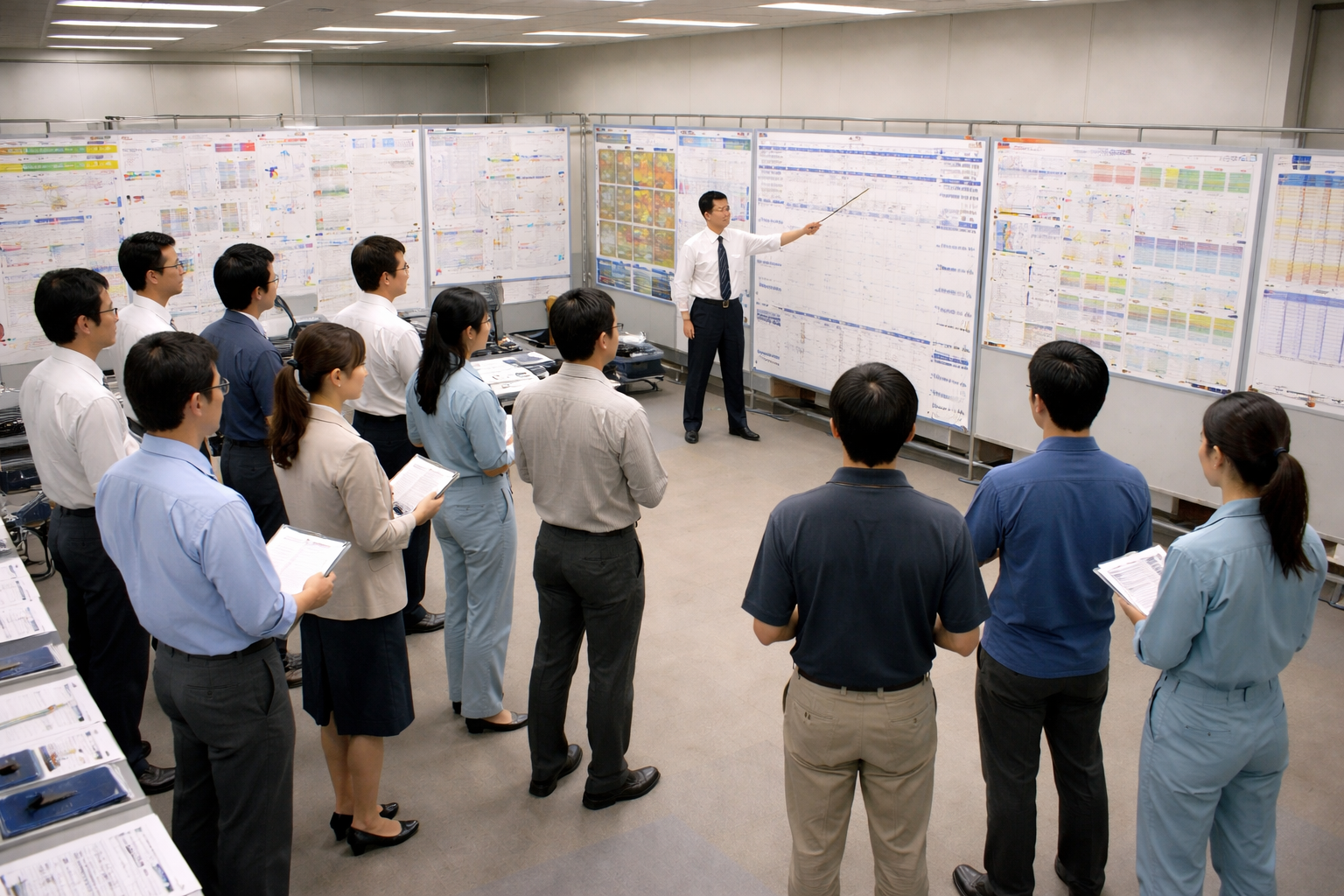
Case Study: Toyota – Obeya in Action During Prius Development
In the early 1990s, Toyota faced a distinctive form of complexity: bringing together an unprecedented combination of technologies, disciplines and organisational capabilities to develop what would become the Prius — the world’s first mass-produced hybrid vehicle. The programme was not simply another product launch. It required fundamental innovation in engine systems, battery engineering, control software, manufacturing integration and global supply coordination. This level of cross-functional complexity stretched the limits of conventional programme management and exposed weaknesses in decision flows buried within functional silos.
Toyota’s response was innovative not in tools but in organisational architecture. Rather than relying on periodic reports, isolated dashboards or sequential approvals, Chief Engineer Takeshi Uchiyamada introduced a new way of working: a dedicated Obeya management environment — literally a “big room” where all leadership functions could meet regularly and work directly from shared, visible information. What emerged was not a project room but a leadership operating system that transformed how decisions were made.
From Fragmentation to Shared Reality
Traditional engineering and programme management often suffer from fractured information flow: each function produces its own status reports, risk assessments and performance indicators, which then have to be reconciled in spreadsheets, meetings or hierarchical reviews. This process creates lag, distortion and a “telephone game” effect where the reality experienced by engineers is not the same reality seen by leadership.
Toyota’s Obeya broke this cycle. In the Obeya space, critical information — design drawings, technical performance metrics, quality indicators, schedule milestones and risk flags — was displayed visually and collectively. But this was not a static set of boards; it was a living workspace. Panels were updated daily. Issues were surfaced as soon as they emerged. Conversations revolved around the data everyone could see at once, rather than summaries that filtered through organisational layers.
This had three important effects:
Shared Reality: Everyone in the room worked from the same visual information. There was no translation, no second-hand reporting, no reconciling multiple versions of the truth.
Faster Escalation: Problems were visible early. Rather than being buried until a checkpoint meeting, issues surfaced in real-time and were addressed immediately.
Collective Decision-Making: Functional leaders did not act in isolation. The Obeya system created a shared decision rhythm where technical, quality and production perspectives were present together — decisions were cross-functional, not sequential.
Structuring Decision Flow, Not Just Information
Crucially, Obeya was not a collection of charts. It was a structured process. Toyota defined:
What information mattered most
Where it should be displayed
Who needed to see it
How frequently it should be reviewed
How decisions would be made and escalated
This structure was supported by a disciplined meeting cadence: daily huddles on critical issues, weekly progress reviews and milestone checkpoints. But these were not presentations. They were conversations driven by visible evidence and collective interpretation.
Leaders moved around the room. They pointed to panels. They made decisions where the information lived. There was no waiting for weekly reports or monthly review packs.
In essence, Obeya turned visual management into governance architecture
Outcomes Beyond Speed
The results of this shift were both tangible and enduring.
The Prius programme, despite its technical novelty, proceeded through development and into production with a level of coherence rarely seen in similarly complex initiatives. Toyota did not publish specific time-to-decision metrics, but practitioners and lean researchers have consistently noted how Obeya reduced rework, improved cross-functional alignment and accelerated problem resolution.
Internally, Obeya became part of Toyota’s product development DNA, influencing how future programmes were governed and how leadership teams operated in complex contexts. Obeya’s legacy is visible in how Toyota connects strategy to execution — not by adding more reporting, but by structuring visibility and decision flow into the leadership routine.
What This Means for Modern Organisations
Toyota’s example demonstrates several principles that are often misunderstood or lost in translation:
Obeya is not a room; it is a leadership system. The physical space matters only insofar as it supports structured, shared visibility.
Information without structure is noise. Obeya makes data meaningful by placing it within governance logic and decision pathways.
Speed and alignment come from shared context, not faster tools. When leaders operate from a common visual reality, decisions happen where the information lives — not in gated review processes.
Today, Obeya has been adopted far beyond automotive manufacturing — from technology organisations to healthcare and finance — because the underlying challenge remains the same: complexity kills clarity, and clarity is a prerequisite for effective leadership.